What Is Security Awareness Training?


Table of Contents
Security awareness training is a structured education program that teaches employees to recognize, report, and resist cyber threats such as phishing, social engineering, and unsafe data handling. It combines short lessons, realistic simulations, and measurable behavior metrics so people become a reliable human firewall—not just a compliance checkbox.
If your organization already runs annual e-learning, you may wonder whether another module changes outcomes. The short answer: only when training is continuous, realistic, and measured against behavior—not completion certificates alone.
Why Security Awareness Training Matters
Most breaches still involve people. Attackers prefer inboxes, SMS, and voice calls over exotic zero-days because social engineering scales. Verizon’s Data Breach Investigations Report series has repeatedly shown that a large share of incidents include a human element—error, misuse, stolen credentials, or social engineering.
Meanwhile, AI has made attacks cheaper and more convincing. Deepfake video, voice cloning, and hyper-personalized phishing mean yesterday’s “hover over the link” advice is not enough. Employees need practice against the threats they will actually see this quarter.
Regulators and insurers notice. Frameworks and standards—from HIPAA and PCI DSS to Cyber Essentials, OSFI, MAS TRM, and GDPR expectations—increasingly expect documented, ongoing security awareness for staff. Boards ask for evidence that human risk is going down, not that a slide deck was assigned.
That is why modern programs treat awareness as an operational control: reduce click rates, raise report rates, shorten time-to-report, and prove culture change with data.
What a Strong Program Includes
Effective security awareness training is more than a once-a-year course. Leading programs typically combine:
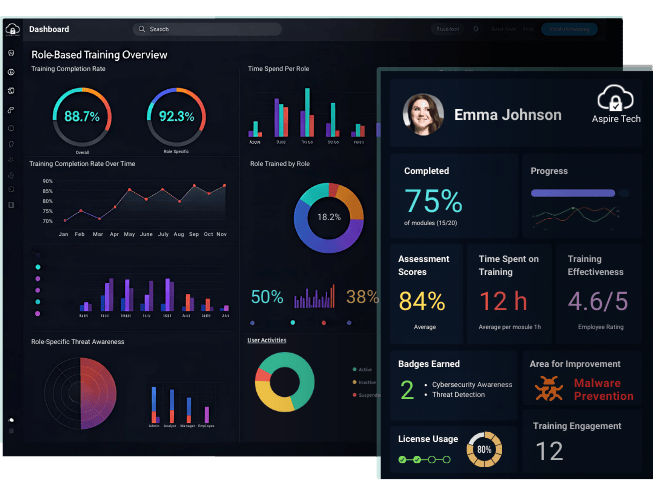
- Role-based learning: Finance, executives, IT, and frontline staff face different risks. Content should match the job. See how role-based training targets those paths.
- Phishing and multi-channel simulations: Email phishing remains core; mature programs also test SMS (smishing), voice (vishing), and emerging deepfake scenarios. Explore AI-powered phishing simulation and phishing awareness training.
- Micro-learning at the moment of failure: When someone clicks a simulation, immediate coaching beats a generic module weeks later.
- Reporting culture: Training should make “report suspicious messages” the default, with frictionless reporting paths.
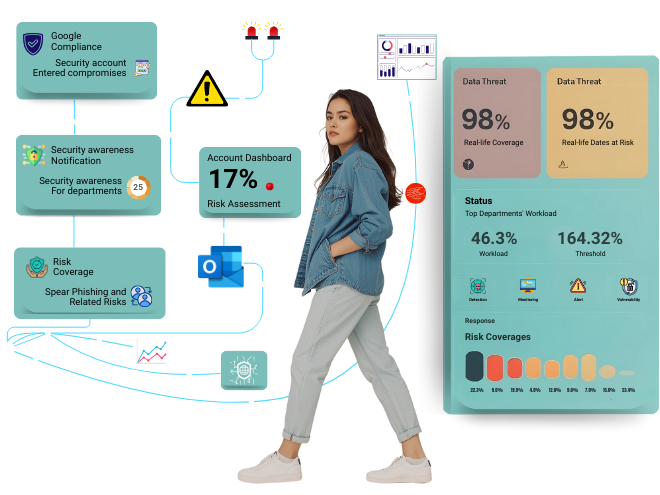
- Analytics and compliance evidence: Dashboards for risk by department, campaign results, completion, and audit-ready exports.
Aspire Tech’s platform (ASAT + APHISH) is built around those pillars: adaptive courses, AI-generated simulations, continuous risk scoring, and automated reporting aligned to common compliance needs.
How to Measure ROI (Beyond Completion Rates)
Completion rates prove assignment, not readiness. ROI and risk reduction show up in behavioral and financial metrics.
1. Phishing simulation failure (click) rate
Track the percentage of users who click or submit credentials in controlled campaigns. A falling fail rate after training and coaching is a direct leading indicator of lower breach likelihood.
2. Report rate and resilience
Measure how often employees report suspicious messages—especially simulated ones. A rising report-to-fail ratio (sometimes called a resilience factor) shows the workforce is acting as a sensor network, not a silent liability.
3. Time-to-report
Minutes matter. Faster reports shrink attacker dwell time for real campaigns that slip past filters.
4. Repeat-offender reduction
Identify users who repeatedly fail simulations and measure improvement after targeted coaching. Concentrated risk is often cheaper to fix than broad, shallow training.
5. Incident and cost proxies
Connect awareness KPIs to business outcomes: fewer successful phishing incidents, fewer BEC near-misses, lower help-desk password-reset load after credential stuffing, and stronger evidence for cyber insurance questionnaires. Industry breach-cost studies vary by year and sector, but even one avoided BEC wire fraud can fund years of training.
A simple ROI framing
ROI ≈ (Avoided incident cost + productivity/insurance benefits − program cost) / program cost. You will not predict avoided breaches perfectly—but you can baseline fail/report rates, set targets (for example, cut click rates by half in 12 months), and report progress to leadership with the same rigor you use for vulnerability remediation.
Aspire Tech Results: Up to 85% Risk Reduction
Organizations using Aspire Tech’s AI-powered awareness and phishing programs have demonstrated large, measurable improvements in human risk indicators. Aspire Tech cites an average risk reduction of up to 85% across customer outcomes—and published customer stories show dramatic phishing reductions in months, not years.
In the case study How TechCorp Reduced Phishing Incidents by 85% in 6 Months, a comprehensive Aspire Tech deployment produced an 85% reduction in phishing incidents alongside strong employee engagement. That outcome mirrors the pattern we see when simulations, adaptive content, and coaching run together instead of as a one-time compliance event.
Those results matter for ROI conversations: fewer successful phishing events mean fewer investigations, less downtime, and stronger proof for auditors and insurers. Explore more industry patterns in our use cases and compare packaging on pricing.
Who Needs Security Awareness Training?
Every organization with email and people needs a baseline. Priority is highest when you:
- Handle regulated data (healthcare, finance, government, education)
- Process payments or wire transfers (BEC exposure)
- Operate distributed or hybrid workforces
- Face frequent phishing or have rising simulation fail rates
- Must produce audit evidence for customers or regulators
Size is not a shield. Small teams are often targeted precisely because controls are lighter. Public-sector and critical infrastructure teams face high-impact consequences from a single compromised account.
How to Get Started
- Baseline: Run a phishing simulation and capture fail/report rates by department.
- Prioritize: Assign role-based modules to high-risk groups first (finance, executives, help desk).
- Coach on failure: Enable point-of-click micro-training and manager visibility for repeat failures.
- Measure monthly: Report fail rate, report rate, and time-to-report alongside completion.
- Iterate: Refresh scenarios as AI-enabled threats evolve; retire stale modules.
Aspire Tech can accelerate that path with adaptive security awareness training, automated simulations, and dashboards built for security and compliance leaders. Request a demo to see how campaigns, risk scores, and reporting work in your environment—or start with a focused pilot via proof of concept.
Related Reading
- AI-Powered vs Traditional Security Awareness Training (2026)
- Security Awareness Training Requirements by Industry
- Certified Not Capable: Why Completion Rates Lie About Readiness
- Complete Security Awareness Training: From Foundation to Armed
- Why organizations choose Aspire Tech
Conclusion
Security awareness training is the operating system for human cyber risk. Defined clearly, delivered continuously, and measured with behavioral KPIs, it turns employees into an early-warning layer attackers cannot easily automate away. With outcome-focused platforms—and results such as Aspire Tech’s up to 85% risk reduction and customer phishing drops of 85% in six months—the business case is no longer theoretical. It is measurable, auditable, and urgent.
Stay Updated
Get the latest cybersecurity insights delivered to your inbox.

Related Articles