AI-Powered vs Traditional Security Awareness Training (2026)

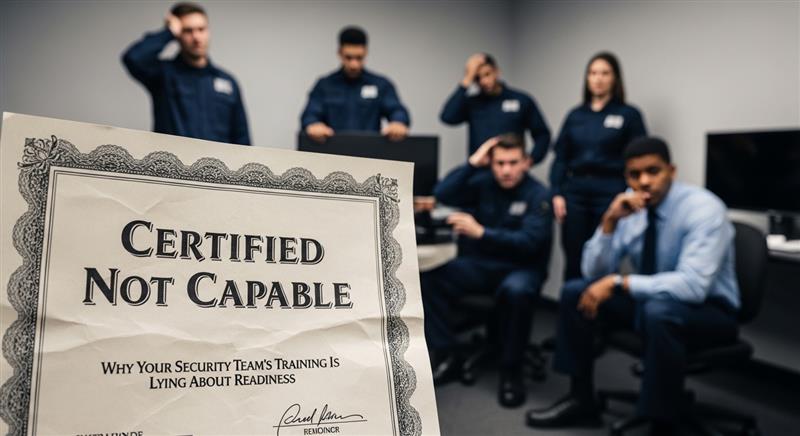
Table of Contents
Buyers searching for AI security awareness training and the best platforms in 2026 are really asking one question: will this change employee behavior against modern attacks, or only produce certificates? This guide compares three common approaches—AI-adaptive platforms, traditional LMS courses, and manual/ad-hoc training—so you can choose with evidence.
Start with the comparison table, then read the detail behind each column. We cite widely referenced industry findings and Aspire Tech customer outcomes so the differences are concrete, not marketing fog.
AI-Adaptive vs Traditional LMS vs Manual Training
| Criterion | AI-adaptive platform | Traditional LMS | Manual / ad-hoc |
|---|---|---|---|
| Content model | Personalized paths by role and risk score | Fixed annual (or quarterly) modules | Slides, emails, one-off briefings |
| Phishing practice | Continuous AI-generated email/SMS/voice/deepfake scenarios | Occasional static templates, if any | Rare IT “gotcha” tests |
| Feedback loop | Point-of-click micro-coaching when users fail | End-of-course quiz score | Little structured feedback |
| Primary metrics | Fail rate, report rate, time-to-report, risk tiers | Completion % and certificates | Anecdotes / attendance |
| Threat freshness | Rapid refresh as AI attacks evolve | Annual content cycle | Irregular updates |
| Admin effort at scale | Automated campaigns and reporting | Cohort assignment + chasing completions | High manual effort, poor scale |
| Compliance evidence | Audit-ready dashboards and exports | Completion records | Spreadsheets / email trails |
| Best fit | Orgs facing phishing/BEC and needing measurable human-risk reduction | Checkbox compliance with limited security staff time | Very small teams with no formal program (temporary only) |
If you only remember one row: completion is not readiness. Traditional LMS and manual programs optimize for proof of assignment. AI-adaptive programs optimize for proof of behavior change.
What “Traditional LMS” Security Awareness Usually Means
A traditional learning management system delivers the same courseware to large cohorts: watch a video, pass a quiz, download a certificate. That model still matters for baseline policy acknowledgment and regulatory checkbox coverage.
Its limits show up under real attacker pressure. Content is slow to refresh. Simulations—if they exist—are static and easy to memorize. Leaders see 95% completion and assume risk is low, while Verizon’s Data Breach Investigations Report series has repeatedly shown that a large share of breaches still involve a human element (error, social engineering, stolen credentials, or misuse).
LMS training is not “bad.” It is incomplete as a standalone human-risk control in 2026.
Why Manual / Ad-Hoc Training Fails at Scale
Manual programs rely on security champions sending tips, running occasional phishing tests in a spreadsheet, or hosting lunch-and-learns. They can create culture sparks in a 50-person company. They collapse under multi-site enterprises, regulated industries, and continuous AI-enabled social engineering.
Without standardized campaigns, you cannot compare departments, prove improvement over time, or satisfy auditors who ask for consistent evidence—not heroic effort.
What AI-Powered Security Awareness Training Changes
Modern AI security awareness training platforms treat employees as dynamic risk signals:
- Adaptive learning: modules adjust by role and individual risk (see also role-based training).
- AI-generated simulations: fresh phishing, smishing, vishing, and deepfake-style scenarios instead of recycled templates—core to phishing simulation and phishing awareness.
- Immediate coaching: micro-training at the moment of a failed simulation, when retention is highest.
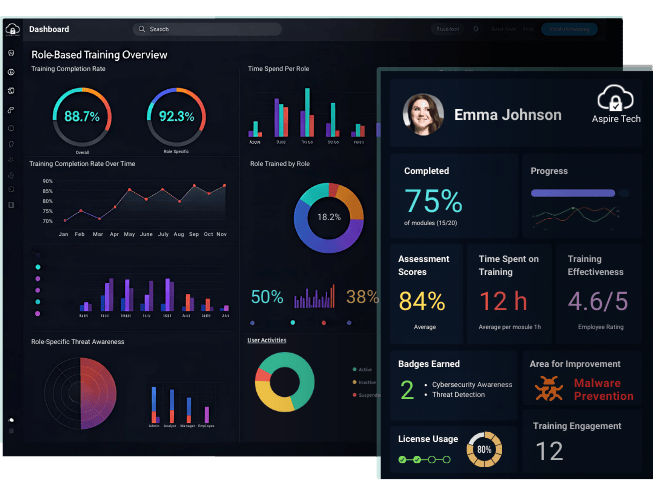
- Behavioral KPIs: click/fail rates, report rates, time-to-report, and repeat-offender trends—not only completion.
That design matches how attacks work in 2026. Proofpoint’s State of the Phish research has highlighted that many employees still take risky actions even when they “know” the rules—and that business email compromise remains widespread. Knowledge without rehearsal does not hold under urgency and realistic AI-crafted lures.
Data Points Decision-Makers Should Cite
- Human factor in breaches: Verizon DBIR editions have consistently attributed a majority share of breaches to human involvement (exact percentages vary by year; use the latest DBIR for board packs).
- Phishing and BEC pressure: Proofpoint’s State of the Phish reports document high rates of risky user actions and frequent BEC exposure across organizations—supporting continuous simulation over annual LMS alone.
- Aspire Tech outcomes: Aspire Tech cites average human cyber risk reduction of up to 85%. The published case study How TechCorp Reduced Phishing Incidents by 85% in 6 Months shows an 85% reduction in phishing incidents after a comprehensive Aspire Tech deployment—evidence that adaptive training + simulations can move operational metrics, not just quiz scores.
For a foundational definition of the discipline itself, read our pillar guide: What Is Security Awareness Training? For regulated verticals, see Training Requirements by Industry.
Best Security Awareness Platforms in 2026: A Buyer Checklist
Rather than a vanity “top 10” list that goes stale, evaluate any platform—including Aspire Tech—against these 2026 criteria:
- Does it personalize by role and risk, or only assign one course to everyone?
- Are phishing (and multi-channel) simulations continuous and fresh, or annual and static?
- Is there point-of-failure coaching when someone clicks?
- Can you export behavioral metrics (fail/report/time-to-report) for leadership and auditors?
- How fast can content/simulations adapt to AI-enabled threats (deepfake, voice clone, hyper-personalized mail)?
- What proof exists of outcome movement (incident or simulation reductions), not only completion?
- Is packaging clear enough to pilot? Compare pricing and run a demo or POC.
Platforms that score well on that checklist are what practitioners mean by the best AI security awareness training platforms in 2026—tools built for measurable human-risk reduction under modern attack conditions.
Which Approach Should You Choose?
- Keep traditional LMS as a policy/compliance baseline if required—but do not treat it as your only phishing defense.
- Avoid long-term manual-only programs once you exceed a few dozen employees or face regulated audits.
- Adopt AI-adaptive training when phishing, BEC, or AI social engineering is a board-level risk and you need metrics that survive scrutiny.
Many organizations run a hybrid: LMS for mandatory policy modules, plus an AI-adaptive layer for simulations and coaching. The hybrid only works if leadership still judges success by behavioral KPIs.
Conclusion
AI-powered security awareness training outperforms traditional LMS and manual programs where it counts in 2026: realistic practice, fast content cycles, and measurable behavior change. Use the comparison table above when briefing stakeholders, cite DBIR/Proofpoint for threat context, and demand outcome proof—such as Aspire Tech’s up to 85% risk reduction and TechCorp’s 85% phishing-incident drop—before you renew another completion-only contract.
Request an Aspire Tech demo to see AI-adaptive campaigns and dashboards in action, or explore why teams choose Aspire Tech.
Stay Updated
Get the latest cybersecurity insights delivered to your inbox.


Related Articles